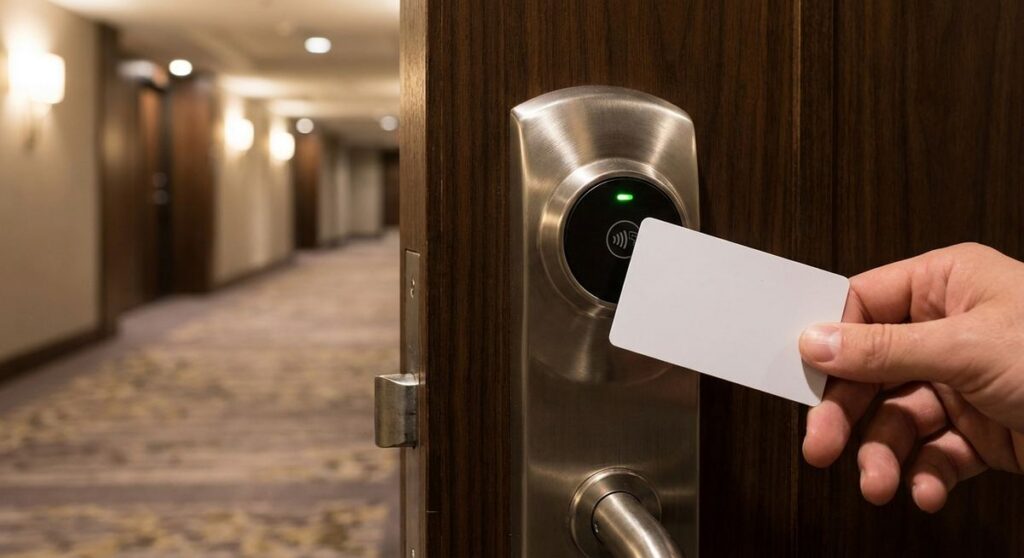
A guest taps a card or a phone, the light turns green, and the door opens. That two-second moment is the most repeated interaction on your property — and it sits on top of a system your engineering and front-office teams have to manage across hundreds of doors, thousands of credentials, and a Miami climate that punishes hardware. Here is what hospitality operators should understand about electronic lock systems in 2026 before the next capital cycle or PIP lands on the desk.
RFID vs. Legacy Magstripe: Why the Shift Is Effectively Complete
Magstripe keys read by physical contact. The card wears, demagnetizes in a wallet next to a phone, and fails at the door — which sends the guest back to the front desk and generates a service ticket that costs staff time and satisfaction scores.
RFID (contactless) locks read a credential over the air, with no swipe, no read head to wear out, and no moving part to jam. The credential itself is encrypted rather than encoded on a magnetic strip, which closes the cloning vulnerability that made older magstripe stock trivially copyable. For most Miami properties, the practical argument is simpler than the security argument: fewer failed reads, fewer front-desk interruptions, and a card stock that survives a pool deck.
If you are evaluating a broader security posture at the same time, our 2026 guide to commercial access control systems for property managers and hotel operators covers how guest-room locks fit alongside perimeter and common-area credentialing.
Mobile Key and BLE Room Entry: Guest Expectation, Not Amenity
Bluetooth Low Energy (BLE) lets a guest’s phone act as the room key, issued through your brand app at check-in. In 2026 this is table stakes for upper-upscale and luxury properties and increasingly expected at select-service.
Operationally, mobile key changes three things:
- Front desk load drops during peak arrival windows, because a share of guests bypass the counter entirely
- Credential issuance becomes remote — a re-key is a push notification, not a walk to the door
- Lock firmware matters — BLE-capable locks need a maintained firmware path, so specify hardware that is still on an active manufacturer roadmap
Keep the physical card as a parallel path. Phones die, guests decline app downloads, and dual-credential properties consistently report fewer service calls than mobile-only rollouts.
Lock Management Software and Audit Trails
The lock is the smallest part of the purchase. The management software is where the operational value lives: credential issuance, expiry rules, staff access profiles, and the audit trail.
A modern system logs every entry attempt at every door — credential ID, timestamp, and result. When a guest reports a missing item, security has a defensible record of who opened that door and when, including housekeeping and engineering entries. Treat that log as sensitive data. The NIST Cybersecurity Framework is a reasonable baseline for how your property should govern access to lock servers, encryption keys, and audit exports, particularly where the lock system touches the PMS network.
Staff Key Hierarchy and Lost-Card Re-Keying
Well-designed properties run a tiered hierarchy: grand master, floor master, section/housekeeping, engineering, and emergency. Each tier should be scoped by area, by shift, and by expiry date. A housekeeping credential that stops working at end of shift is not an inconvenience — it is the difference between a controlled property and an open one.
Lost or unreturned staff cards are the real test. In an electronic system, voiding a credential is a software action that propagates to affected doors, not a physical re-key across a floor. Confirm during procurement how quickly a voided credential is actually enforced at offline battery-powered locks, since that propagation model varies significantly by manufacturer.
Battery and Maintenance Planning Across Hundreds of Doors
Battery-powered locks fail predictably if you plan and unpredictably if you do not. Build a program that includes:
- A scheduled replacement cycle rather than run-to-failure, batched by floor
- Low-battery reporting pulled from the management software into your PM system
- An emergency override method — mechanical key or portable programmer — documented and stocked at the front desk
- Spare lock bodies and readers on site so a failed unit is swapped, not ordered
Integration With Elevator Access and Back-of-House
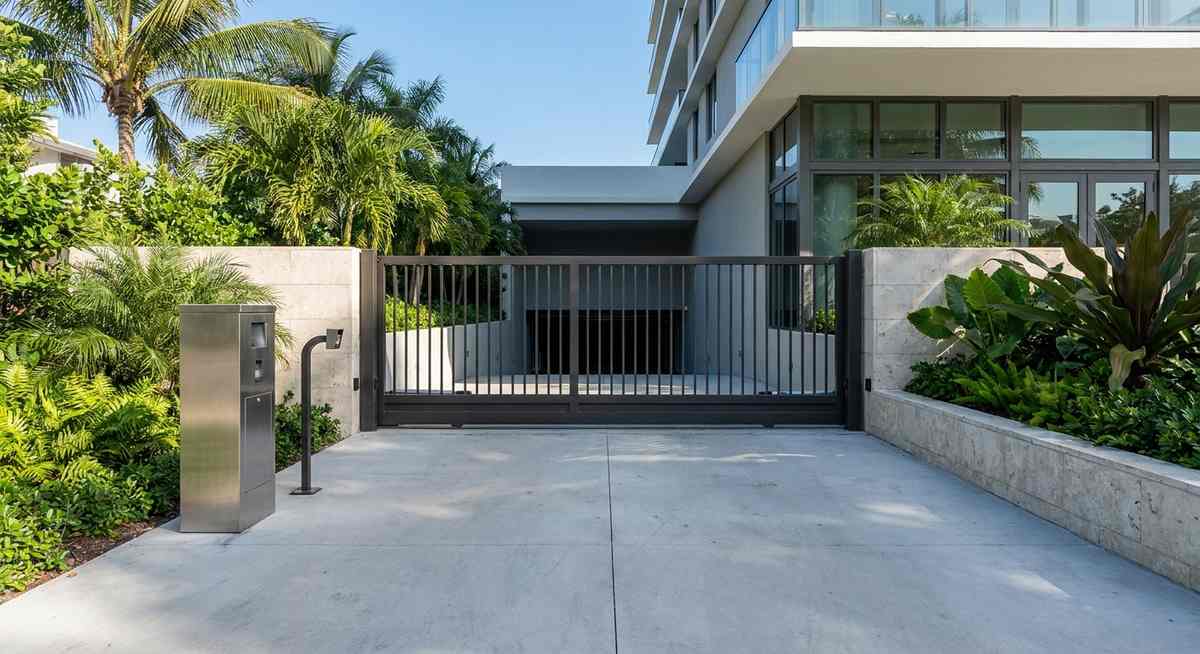
The same credential that opens a guest room should govern elevator floor access, amenity spaces, parking gates, and back-of-house corridors. That integration is where the security model actually becomes coherent — a guest credential reaches only their floor, staff credentials reach service areas, and both are logged in one place.
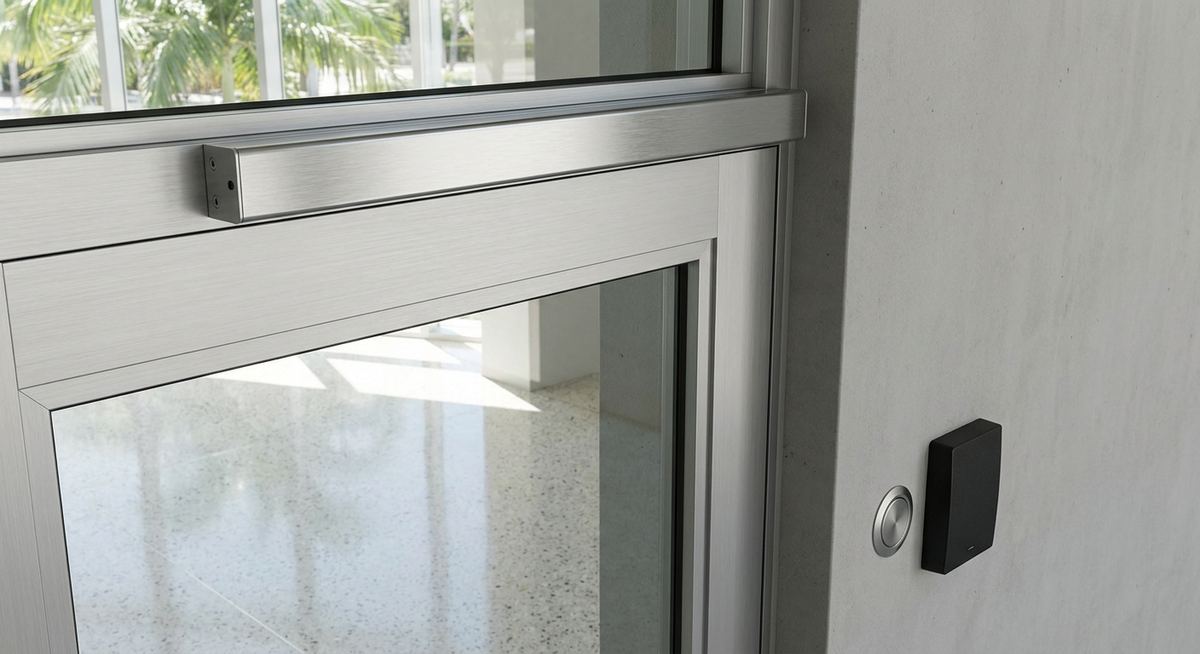
Back-of-house and service openings usually need different hardware than guest rooms: heavier cycle ratings, electric strikes, and rated assemblies. Our commercial door services and metal door work cover the frame and door side of that equation, which is frequently the constraint on what lock hardware can even be installed.
ADA and Life-Safety Considerations
Electronic locks do not exempt an opening from accessibility or egress requirements. Operating hardware must remain usable without tight grasping, pinching, or wrist twisting, and reach ranges still apply — review current guidance directly at ADA.gov. On the life-safety side, guest room and stair doors must allow free egress at all times, and fire-rated openings must retain listed hardware and closers; NFPA standards and the Florida Building Code govern how far you can go. Any retrofit that changes latching, closing, or door prep should be reviewed against the rated assembly before install.
Miami-Specific Realities
Hurricane season power interruptions. Battery-powered guest locks keep working through an outage, but the servers, encoders, and elevator controllers do not. Verify what stays on generator or UPS and rehearse the manual credentialing procedure before June.
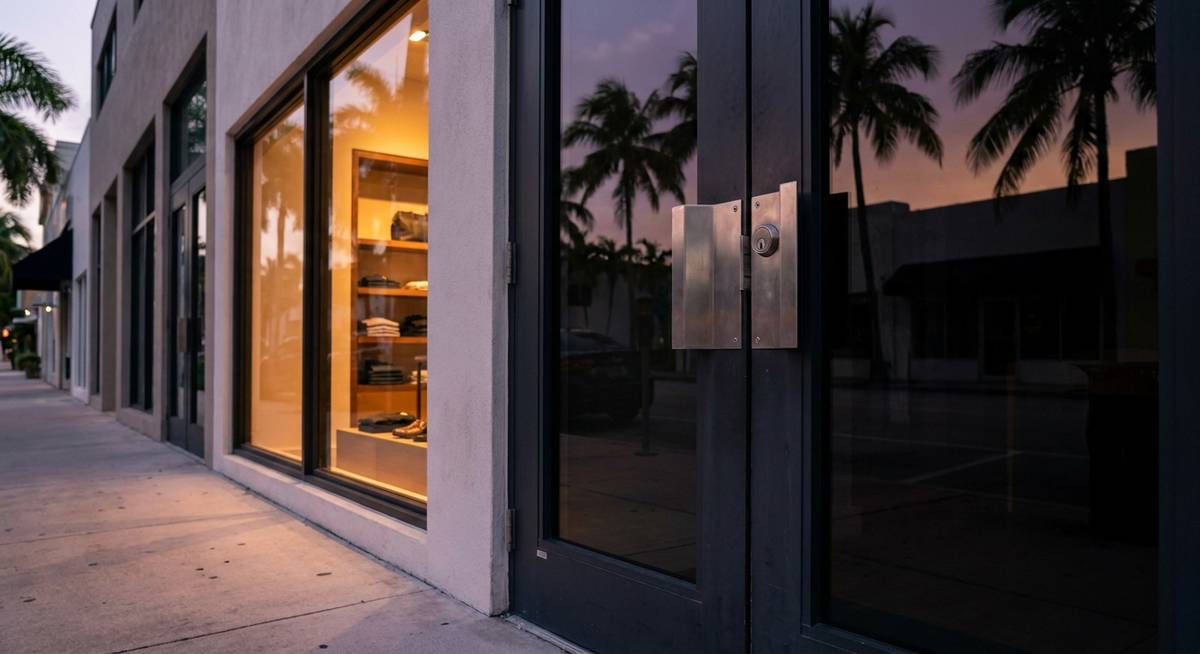
Salt-air corrosion. Exterior and semi-exposed hardware near the water degrades faster than spec sheets suggest. Specify appropriate finishes and gasketing on balcony, pool, and beach-access doors, and add those openings to a corrosion inspection cycle.
Seasonal turnover. High-volume winter occupancy compresses your maintenance window. Front-load lock work into shoulder season.
Planning a Property-Wide Retrofit With Minimal Guest Disruption
Retrofits succeed when they are sequenced, not rushed. Pilot one floor, validate the software and PMS integration, then roll floor by floor against the occupancy forecast — typically 20 to 40 doors per day with a two-tech crew. Run old and new credentials in parallel during the transition, and brief the front desk before each floor goes live. We manage this kind of phased work through our commercial projects team, and keep 24/7 emergency locksmith support available throughout the cutover.
Talk to a Commercial Security Partner Who Knows Miami Hospitality
Miami Doors & Locks installs and services hotel RFID and key card lock systems, access control, elevator credentialing, and commercial door hardware across greater Miami, with 24/7 emergency response. As an authorized Mul-T-Lock and Medeco dealer working with hospitality, condo, retail, and institutional properties, we can assess your current lock platform and build a retrofit plan around your occupancy calendar. Contact our commercial team to schedule a property walkthrough.
Miami Doors & Locks — 1601 NW 54th St, Miami, FL 33142 · (305) 576-9320 · https://www.miamidoorsandlocks.com