An accessibility complaint rarely starts with a lawsuit. It starts with a customer who could not open your front door.
For Miami condo associations, hotels, retail centers, medical offices and banks, the entrance is both the first impression and the most-regulated square footage on the property. Automatic door operators solve the accessibility problem and the traffic-flow problem at once — but only if they are specified, installed and maintained correctly.
Here is what commercial property managers in Miami need to understand.
Why This Is on Your Radar Now
Accessibility enforcement is driven by both federal law and the building code, and the requirements interact. The Americans with Disabilities Act sets the civil-rights obligation for places of public accommodation. The International Building Code, published by the International Code Council, sets the construction requirements enforced locally by your building department.
Two practical realities follow. First, compliance is not a one-time achievement — a door that passed inspection five years ago may not comply today, because closers drift, hardware loosens and thresholds shift as buildings settle. Second, any renovation or hardware replacement typically triggers a fresh compliance obligation for that element.
The Baseline Requirements
Whether or not a door is automatic, accessible entrances share core requirements:
- Clear opening width of at least 32 inches with the door open at 90 degrees
- Opening force for interior hinged doors not exceeding 5 pounds
- Maneuvering clearance on both approach sides, with dimensions that change based on approach direction and whether the door is push or pull side
- Hardware operable with one hand without tight grasping, pinching or wrist twisting — which rules out traditional round knobs
- Threshold height limited at the transition
- Closing speed slow enough to allow safe passage
When an existing door cannot meet the opening-force requirement — heavy storefront glass, doors fighting stack pressure or wind, fire-rated assemblies with strong closers — an automatic operator is usually the cleanest solution rather than a workaround.
Low-Energy vs. Full-Power Operators
These are different products governed by different standards, and specifying the wrong one creates both a safety and a compliance problem.
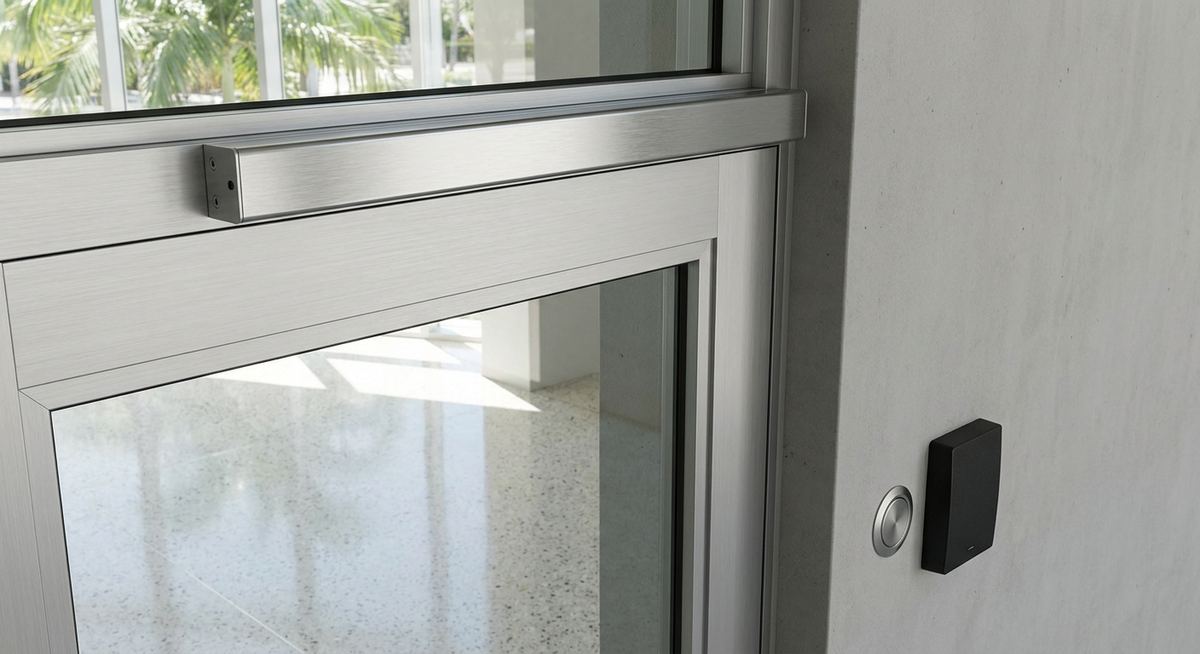
Low-energy operators activate on user input — a push plate, wave sensor or switch. They open slowly with limited force, which is why they generally do not require the same presence-sensing package. These are the right choice for most office suites, restrooms, medical entrances and interior accessible doors.
Full-power operators open automatically on approach detection at conventional speed. Because a user may not expect the movement, these require a comprehensive sensor package — typically both approach-side and door-side presence sensing — plus guide rails or safety barriers depending on the configuration. These suit high-traffic retail, hotel and lobby entrances.
Each category is governed by its own ANSI/BHMA standard covering performance, safety and installation. Your authority having jurisdiction may impose additional sensor requirements based on site conditions.
Where Fire Ratings Complicate Things
This is the detail most commonly missed on Miami commercial projects.
If the door assembly is fire-rated, the automatic operator must be listed for that specific rating and must interface with the building fire alarm system. Common configurations include hold-open operators that release on alarm, and low-energy operators that revert to closer-only function when an alarm signal is received.
You cannot simply mount a standard operator on a rated door. NFPA 80 governs the inspection and maintenance of fire door assemblies, and modifying a rated assembly with unlisted hardware voids the rating — which surfaces at the worst possible moment, during an annual fire door inspection or after an incident. Our work on fire-rated and metal doors covers rated assemblies specifically.
Security and Accessibility Are Not Opposites
Property managers often assume an automatic entrance weakens security. Done properly, it does the opposite, because the operator becomes an integrated part of the access control system rather than a hole in it.
A typical Miami commercial configuration:
- Credential reader — card, fob or mobile credential at the entry
- Electric strike or maglock releasing on valid credential
- Automatic operator triggered only after the lock releases
- Fire alarm interface for code-compliant egress
- Door position monitoring reporting held-open or forced-open conditions
- Camera coverage at the entrance tied to access events
The result is a fully accessible entrance where every entry is logged and no unauthorized access is possible. We integrate operators with commercial door systems and access control on new installs and retrofits alike.
Miami-Specific Considerations
Our climate is hard on entrance hardware. Salt air corrodes sensors and mechanisms, especially on beachfront and Intracoastal properties. Humidity affects electronics. Wind pressure on tall buildings alters the actual force needed to move a door, which is why a door tested on a calm morning can fail on a windy afternoon.
Hurricane preparedness matters too. Entrance systems in impact-rated openings need hardware compatible with the assembly, and the operator must fail safe for egress during a power loss.
What an Assessment Covers
Before recommending hardware, we walk the property and document:
- Measured opening force on every public-facing door
- Clear width and maneuvering clearance at each accessible entrance
- Existing hardware type and whether it meets one-hand operation
- Threshold heights and transitions
- Fire ratings and current NFPA 80 compliance status
- Existing access control and how an operator would integrate
- Realistic prioritization — what needs correction now versus what can be scheduled
Larger properties are handled through our commercial projects team, which coordinates multi-door rollouts across a portfolio.
Book a Commercial Door Assessment
We are an authorized Mul-T-Lock and Medeco dealer serving Miami’s condo associations, hotels, retailers and banks — including Ritz-Carlton, InterContinental and Setai properties — with 24/7 emergency response.
Schedule your assessment with Miami Doors & Locks
Miami Doors & Locks — 1601 NW 54th St, Miami, FL 33142 — (305) 576-9320 — 24/7 service — https://www.miamidoorsandlocks.com