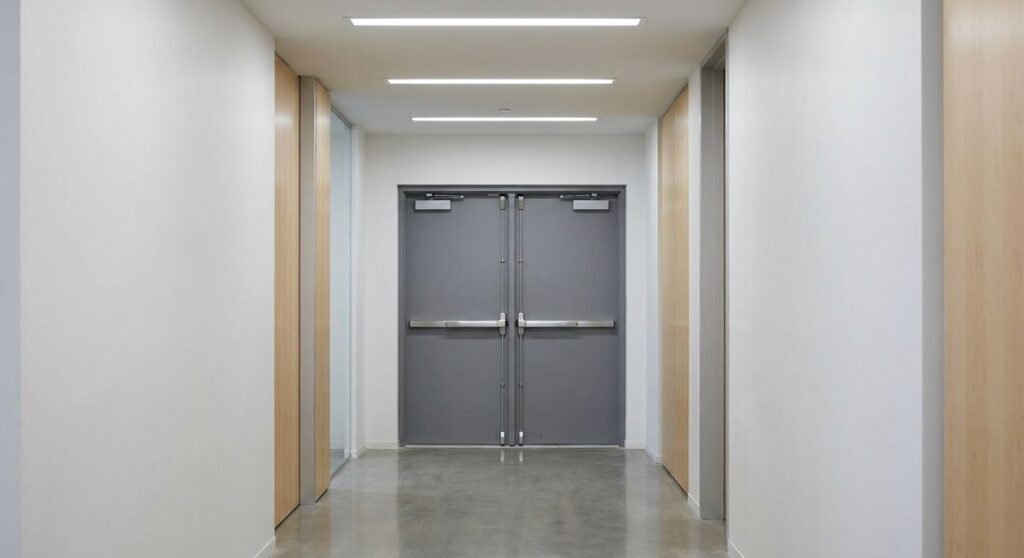
Panic hardware is the piece of building hardware most likely to fail an inspection and least likely to get attention until it does. It is also the piece most likely to be defeated by a well-meaning employee with a chain and a padlock.
If you manage a restaurant, retail space, hotel, school, house of worship, warehouse, or office building in Miami, this is the practical version of what the code requires and where buildings actually get written up.
What Panic Hardware Is — and What It Is Not
Panic hardware is a door-latching assembly with a horizontal push bar or push pad that releases the latch when pushed in the direction of egress. The defining requirement is that the door opens with a single motion, using no key, no tool, no turning, and no prior knowledge.
Two terms get used interchangeably but are not identical:
- Panic hardware — required for egress in assembly, educational and high-hazard occupancies at certain occupant loads.
- Fire exit hardware — panic hardware that is also listed for use on fire-rated door assemblies. It is panic hardware plus a fire rating, and it must be labeled as such.
Installing standard panic hardware on a fire-rated door is a code violation and voids the door’s rating. This is one of the most common findings we correct in Miami buildings.
When Panic Hardware Is Required
The general framework: NFPA 101, the Life Safety Code, requires panic hardware on egress doors serving assembly and educational occupancies once the occupant load reaches 100 — theaters, auditoriums, restaurants, bars, nightclubs, schools. The International Building Code sets the threshold at 50 for assembly and educational occupancies. Florida adopts NFPA 101 and enforcement happens locally through your Authority Having Jurisdiction — typically the county or municipal fire marshal.
Business, mercantile and residential occupancies — offices, most retail, apartment buildings — generally do not require panic hardware on their doors, unless the building contains an assembly, educational or high-hazard area that crosses the occupant load threshold. A corporate office with a 120-seat training auditorium is exactly that case.
Three additional situations require panic hardware regardless of occupant load:
- Doors serving rooms with certain electrical equipment, where the equipment rating triggers the requirement.
- Doors in refrigerated and walk-in spaces with specific configurations.
- Doors serving high-hazard occupancies, including certain storage and chemical areas.
Florida’s Building Code and Product Approval system governs the products themselves, and Miami currently enforces the 8th Edition (2023) Florida Building Code. For the egress principles behind all of it, OSHA’s exit route requirements are a useful plain-language reference for employers.
The Technical Requirements That Get Missed
Even where hardware is installed, inspectors commonly find these problems:
- Mounting height. The actuating bar must sit between 34 and 48 inches above the floor.
- Bar length. The push bar must extend at least half the width of the door leaf. On balanced doors requiring panic hardware, push-pad type is required and the pad must not extend more than half the door width from the latch side.
- Listing. The hardware must be listed to UL 305 (and to UL 10C for fire exit hardware). Unlisted hardware is an automatic finding.
- Single-motion operation. Any add-on device — a surface bolt, a thumb turn, a hasp, a second lock — that requires a separate action defeats compliance.
- Fire-rated door assemblies. Fire exit hardware must be labeled, the closer must be functional, and the door must positively latch. A fire door that does not latch is not a fire door.
- Signage and dogging. Mechanical dogging (holding the latch retracted) is not permitted on fire exit hardware.
The Violation We See Most: Locked or Blocked Exits
Chained exit doors, deadbolted rear doors at closing time, exits blocked by pallets or dumpsters, and “employees only — keep locked” signs on egress doors. Every one of these is a serious life-safety violation, and every one of them has a legitimate root cause: the owner is worried about theft, loitering, or unauthorized entry.
The solution is not a chain. It is hardware that solves both problems at once:
- Panic hardware with exterior key access only — free egress out, controlled entry in. This is the correct answer for the vast majority of back-door situations.
- Delayed-egress hardware where permitted by the AHJ, allowing a 15-second delay with the required alarm and signage.
- Alarmed exit devices that sound locally when the door is used, deterring casual misuse without impeding egress.
- Access control integration so the door reports to your system rather than being physically secured.
We handle this work through our commercial door services and pair it with access control where a building needs both compliance and real security. For hollow metal openings, our steel door and metal door work covers frame repair and prep for exit devices — often necessary in older Miami buildings where the frame has corroded around the strike.
A Quarterly Walk-Through You Can Do Yourself
Take fifteen minutes and check every egress door in your building:
- Does it open with one push, no key, no turning?
- Is the push bar between 34 and 48 inches high and at least half the door’s width?
- Is anything chained, bolted, or wedged?
- Is the path outside the door clear of pallets, carts, and dumpsters?
- Does the door close and latch fully on its own?
- Is exit signage lit and visible?
- Is there a UL label on the hardware and, for fire doors, on the door and frame?
Anything that fails is worth fixing before an inspection or an emergency finds it first.
Get Your Egress Hardware Assessed
Miami Doors & Locks works with condo associations, hotels, retailers, banks, restaurants and construction firms across greater Miami — with 24/7 emergency locksmith response when a door fails at the wrong moment. Learn more about our team.
Schedule a commercial egress hardware assessment →
Miami Doors & Locks — 1601 NW 54th St, Miami, FL 33142 — (305) 576-9320 — https://www.miamidoorsandlocks.com