September is the statistical peak of the Atlantic hurricane season, and for commercial property in Miami-Dade that means the window for preparation is now — not when a cone appears on the map. By the time a storm is 72 hours out, locksmiths, door contractors, and hardware suppliers across South Florida are fully committed, and the parts you need are gone.
Most businesses handle the obvious items. Shutters get checked, generators get fueled, roof drains get cleared. Doors and door hardware get skipped almost universally, which is unfortunate, because the door line is where a surprising number of storm failures start — and where nearly all post-storm security problems occur.
Why Doors Matter More Than People Think
Wind does not destroy a building by pushing on it evenly. It finds an opening. Once the building envelope is breached — a failed window, a door that blows in — internal pressure rises rapidly and the wind is suddenly working from the inside out against the roof and walls. Guidance from FEMA on wind-resistant construction consistently identifies openings as the critical vulnerability in high-wind events.
Exterior doors are openings. A metal door in a corroded frame, with a worn latch and a hinge screw backed halfway out, is not going to hold in a Category 2 wind load — and when it goes, the consequences are not limited to that doorway.
Pre-Season Inspection: What to Actually Look At
Walk every exterior opening on your property with this list. It takes about twenty minutes for a typical commercial building and it is the highest-value maintenance hour you will spend this month.
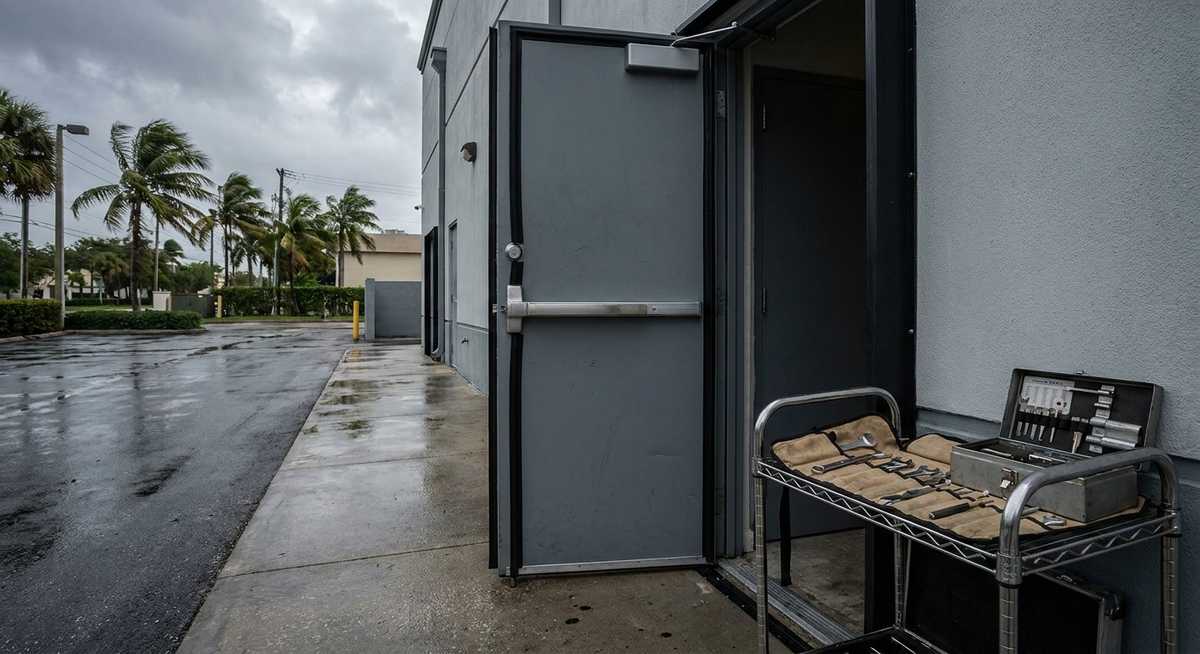
Frames and anchoring. Look for rust at the base of hollow metal frames, especially on the ground floor and in loading areas where water pools. A frame corroded through at the anchor points has no meaningful wind resistance regardless of how good the door is. Check that anchors are still tight in the substrate.
Hinges. Count the screws. Loose or missing hinge screws are extremely common and trivially fixable. On heavy exterior doors, verify that hinges are appropriately rated and that at least one continuous or heavy-duty hinge is in place where required.
Latching and locking hardware. Every exterior door should latch fully and positively without being pulled or lifted. A door that needs a shoulder to close is not sealing. Verify deadbolt throw and that the strike plate is anchored into structure, not just into the frame skin.
Weatherstripping and sweeps. Water intrusion during a hurricane is largely a sealing problem. Replace compressed, cracked, or missing perimeter seals and door sweeps. This is cheap and it is one of the few storm measures that also lowers your cooling bill year-round.
Glass doors and storefronts. Check the condition of glazing and of frame-to-glass seals. Confirm that any glass door hardware is not the weak link in an otherwise protected opening.
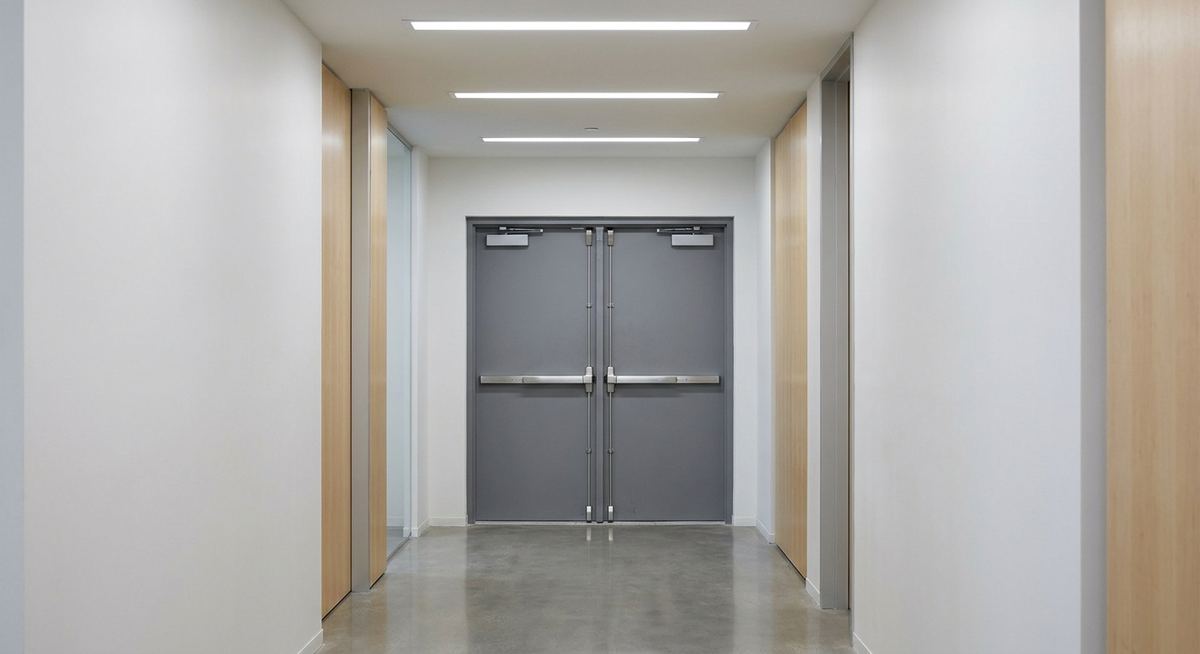
Exit devices and panic hardware. These have to work during and after a storm, when the building may be dark and occupied. Verify smooth operation and that dogging mechanisms are set correctly for your occupancy.
The Hardware That Actually Holds
If you are replacing doors this season rather than repairing them, this is the moment to specify correctly rather than cheaply.
Commercial metal and steel doors in properly anchored hollow metal frames are the baseline for exterior openings on commercial property in a hurricane zone. Miami-Dade County maintains among the most demanding product approval requirements in the country for windborne debris regions, and door assemblies for exterior use in the High-Velocity Hurricane Zone are expected to carry appropriate approval — a requirement worth verifying with your supplier before installation, not after an inspection.
For high-security openings, the same logic applies to cylinders. High-security lock platforms provide drill and pick resistance and — more relevant here — controlled key duplication, which becomes important the moment a storm forces you to hand keys to contractors, remediation crews, and adjusters. Our commercial door services cover assembly, hardware, and cylinder specification as one package rather than three separate problems.
Access Control and Power Loss
This is the failure mode that catches property managers by surprise every season.
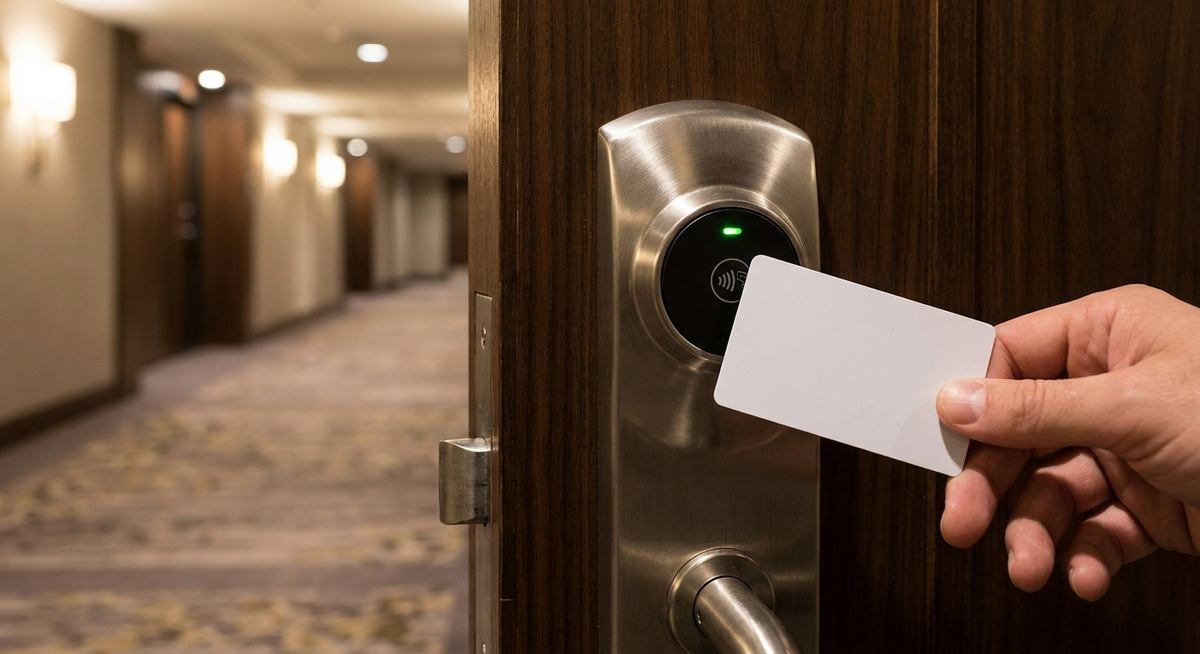
Electronic access control behaves differently depending on how it is configured. Fail-safe hardware unlocks when power is lost. Fail-secure hardware stays locked. Both are correct in different applications, and life-safety codes dictate which is required where — but you need to know, in advance, what every controlled door on your property will do the moment the power goes out.
A building where every access-controlled door fails open during a five-day outage is a building with no security at all during exactly the period when looting risk is highest. A building where fail-secure doors lock occupants in without a compliant mechanical egress path is a life-safety violation. Neither is discovered at a good time.
Questions to answer now:
- Which doors are fail-safe and which are fail-secure?
- Is there battery backup on the access control panel, and how long does it actually last?
- Do card readers and electric strikes come back online correctly after power is restored, or do they need a manual reset?
- Do you have mechanical key override on every controlled opening, and does someone on site have those keys?
- Where are the credentials and the panel programming backed up?
Test this before the season peaks. The National Hurricane Center is the authoritative source for tracking active systems, but no forecast gives you enough lead time to fix an access control architecture problem.
During the Storm
Keep it simple. Secure and lock all exterior openings. Do not brace doors in ways that block required egress for anyone sheltering on site. Move valuable inventory and documents away from ground-floor door lines where water will enter first. Confirm that whoever is responsible for the property has mechanical keys, not just a badge.
After the Storm: The Part Nobody Plans For
Post-storm is when the actual security losses happen, and it follows a consistent pattern in South Florida.
Doors are damaged or forced. Frames are racked out of square so doors will not latch. Power is out so access control is down. Buildings sit open while owners cannot reach them. Contractors, remediation crews, and inspectors come and go with keys that were handed out in a hurry and never recovered.
The priority sequence that works:
- Secure the perimeter first, before cleanup. A door that will not latch needs a temporary secure closure the same day.
- Document everything with photographs before repairs, for your insurance claim.
- Re-key aggressively once crews leave. Every key issued during an emergency should be considered compromised. Re-keying a commercial building is far cheaper than the alternative.
- Verify access control integrity — panels, readers, strikes, and credential lists — before relying on it again.
- Replace, do not patch, racked frames. A frame out of square never latches properly again and becomes a permanent security gap.
Our 24/7 emergency locksmith service exists for exactly this window. Board-up, temporary securing, emergency re-key, and lock replacement are what the days after a storm demand, and they demand them from everyone at once.
Get Your Doors Inspected Before the Peak Passes
We serve condo associations, hotels, retail, banks, and commercial property across greater Miami, and we would rather inspect your openings in September than replace them in October.
Schedule a commercial door and hardware inspection
Miami Doors & Locks — 1601 NW 54th St, Miami, FL 33142 — (305) 576-9320 — https://www.miamidoorsandlocks.com