Miami commercial property owners face some of the most demanding building code environments in the country — and fire-rated door compliance sits squarely in the crosshairs of annual inspections. Whether you manage a condo tower in Brickell, a hotel corridor in South Beach, or a retail strip in Doral, the Florida Building Code’s adoption of NFPA 80 requires that every fire door assembly be inspected, documented, and performing to standard every single year. Falling short doesn’t just mean a citation — it can mean failed occupancy inspections, voided insurance coverage, and real liability if a fire event occurs.
What Is NFPA 80 and Why Does It Apply to Miami Properties?
NFPA 80, the Standard for Fire Doors and Other Opening Protectives, is published by the National Fire Protection Association and sets the national baseline for fire door installation, hardware, clearances, and ongoing maintenance. Florida adopted it into the Florida Building Code, which means compliance isn’t optional — it’s a legal requirement for all commercial properties in Miami-Dade County.
The core NFPA 80 rule every property manager should know: all fire door assemblies must be inspected and tested at least annually, with written records kept on-site. The inspection must verify:
- Door and frame labels are intact and legible (both the door leaf and the frame must carry a listed UL label)
- Clearances between door and frame are within specification — no more than 1/8 inch at the hinge edge and top, no more than 3/16 inch at the strike edge for pairs, and no more than 3/4 inch at the bottom
- The door closes and latches fully without human assistance — door closers and positive-latching hardware are mandatory
- No unauthorized modifications have been made to the assembly (field-welded holes, incorrect hardware, non-listed hold-opens are all violations)
- No wedges, door stops, or chains are being used to prop fire doors open — the only compliant hold-open device is a listed electromagnetic unit wired directly to the building fire alarm system
Inspections that turn up deficiencies require documented corrective action. If a fire door cannot be immediately repaired, it must remain closed and latched until compliant hardware is installed.
Fire-Rated Metal and Steel Doors: What Makes Them Different
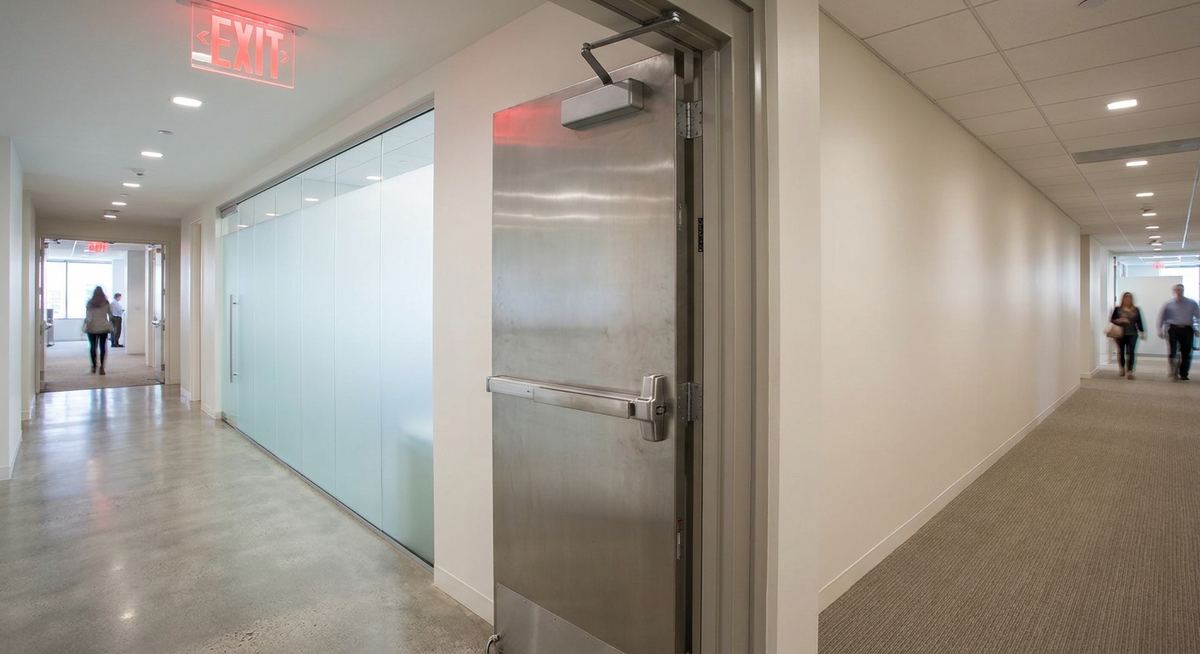
Not every steel door is a fire door. A fire-rated door assembly is a complete, tested unit — door leaf, frame, hardware, glazing (if any), and seals — all tested together as a system by a recognized testing laboratory such as UL, Intertek, or Warnock Hersey. The fire-rating period — typically 20, 45, 60, or 90 minutes — tells you how long the assembly is certified to contain flames and smoke under controlled test conditions.
Miami commercial properties most commonly encounter fire doors at:
- Stairwell and exit enclosures — typically 90-minute ratings required by the IBC
- Corridor separations and tenant demising walls — 20 to 45-minute ratings common in office buildings and multi-family corridors
- Mechanical and electrical rooms — often 45- or 60-minute rated to protect critical building infrastructure
- Hotel back-of-house corridors — especially relevant for properties under the jurisdiction of NFPA 101, the Life Safety Code
Miami Doors & Locks supplies and installs metal and steel commercial doors that carry the appropriate UL or third-party fire labels, paired with frames sourced to match the door’s rated assembly. Using a non-listed frame with a listed door — or vice versa — invalidates the entire assembly and will trigger an inspection failure.
The Florida-Specific Compliance Layer
Beyond NFPA 80, Miami commercial projects have to satisfy Miami-Dade County’s Notice of Acceptance (NOA) process for exterior openings. The NOA system requires product-specific testing for wind load performance, which affects exterior hollow metal door frames and threshold hardware in buildings located in wind-borne debris regions. This matters when you’re replacing or upgrading building perimeter doors — the documentation trail has to be complete before the building inspector signs off.
ADA compliance adds another dimension. Door closer force limits, threshold height maximums (no more than 1/2 inch for accessible routes), lever-style hardware, and maneuvering clearances are all subject to inspection under Florida’s accessibility code. A steel door that passes fire inspection can still fail an accessibility review if the closer is set too heavy or the threshold is too high.
Properly specifying and installing a commercial door in Miami requires coordinating fire rating, wind load approval, ADA hardware, and frame labeling — all documented and submitted before the rough-in inspection closes. Missing any one of those elements can delay a certificate of occupancy or trigger a forced field correction that’s far more expensive than getting it right upfront.
Common Fire Door Violations Miami Inspectors Find
According to fire door inspection data and industry guidance from NFPA, the most frequently cited violations during annual inspections include:
- Missing or damaged UL labels — painted over, corroded, or removed during renovation
- Excessive door-to-frame clearance — caused by worn hinges, settling frames, or improper original installation
- Failed or missing door closers — doors that don’t close and positively latch under their own power
- Improper hold-open devices — rubber wedges and chain tie-backs are extremely common in busy commercial corridors and are prohibited under NFPA 80
- Unauthorized frame modifications — conduit penetrations, welded brackets, and re-drilled hinge locations that were never part of the tested assembly
- Non-listed vision lite kits — adding a glass view panel to a fire door using hardware that wasn’t part of the original UL test invalidates the fire rating
Any of these deficiencies documented during an annual inspection must be corrected and re-inspected. Building owners who ignore written deficiency reports face escalating liability exposure, particularly in the post-Surfside regulatory climate where Florida has tightened building inspection enforcement significantly.
Why Miami Properties Should Audit Their Fire Doors Now
Mid-year is a smart time for Miami commercial property managers to schedule a fire door audit for three reasons. First, building inspection season ramps up in fall, and proactive identification of deficiencies gives you time to source correct hardware and schedule installation without rushing. Second, if you completed any renovation work or tenant improvement projects since your last annual inspection, new penetrations, re-hung doors, or replaced hardware may have inadvertently introduced violations. Third, insurance underwriters are increasingly scrutinizing fire door compliance documentation as part of commercial property renewals — having a current, clean inspection report is a tangible underwriting asset.
For properties that need to bring multiple fire doors into compliance simultaneously — a common situation in older Miami office buildings and pre-code condo towers — a phased commercial door project approach allows you to prioritize the highest-risk openings first, document corrective actions, and spread installation costs across the fiscal year.
What to Look for in a Miami Commercial Door Contractor
NFPA 80 compliance work requires a contractor who understands the full assembly — not just the door leaf. When evaluating providers for fire door supply, installation, or inspection work in Miami, look for:
- Familiarity with UL labeling requirements for both door and frame
- Ability to source replacement hardware from the original manufacturer’s listed hardware schedule (substituting non-listed hardware invalidates the rating)
- Experience with Miami-Dade NOA documentation for exterior openings
- A documented installation process that generates the paperwork an AHJ (authority having jurisdiction) expects to see
- Verified experience with the types of assemblies common to your property type — hotel corridors, high-rise stairwells, and retail strip centers each have different rated opening requirements
For an authoritative resource on fire door inspection requirements, the Door Security & Safety Foundation publishes free guidance for building owners and facility managers. The CISA Physical Security Guidance also covers integration of fire-rated opening protectives with broader access control and emergency egress planning.
Schedule Your Fire Door Inspection and Compliance Work in Miami
Miami Doors & Locks serves commercial and multi-family properties throughout greater Miami with fire-rated door supply, installation, and hardware compliance services. From hollow-metal door frames with proper UL labeling to emergency hardware upgrades that bring existing assemblies back into NFPA 80 compliance, our team handles the full scope — supply, installation, documentation, and follow-up.
Get a Commercial Door Compliance Consultation Today
If your property’s fire doors haven’t been formally inspected this year, or if you’re planning a tenant improvement or renovation that touches rated openings, contact Miami Doors & Locks now. We’ll assess your current inventory, identify deficiencies before an inspector does, and provide a clear corrective action plan — before it becomes an emergency.
Schedule Your Commercial Door Inspection
Miami Doors & Locks | 1601 NW 54th St, Miami, FL 33142 | (305) 456-2080 | miamidoorsandlocks.com